The first locomotive works
George and Robert Stephenson set up the works here in 1823 with Edward Pease and Thomas Richardson. Locomotion No. 1 for the Stockton and Darlington Railway was built here in 1825.
 Cairn
British History Quest

Every November Britain remembers those who died in war. Poppies grew on the churned-up battlefields of Flanders, and at eleven o'clock on 11 November 1918 the guns of the First World War fell silent.
The day the guns fell silent →September 1829 · Rocket before Rainhill
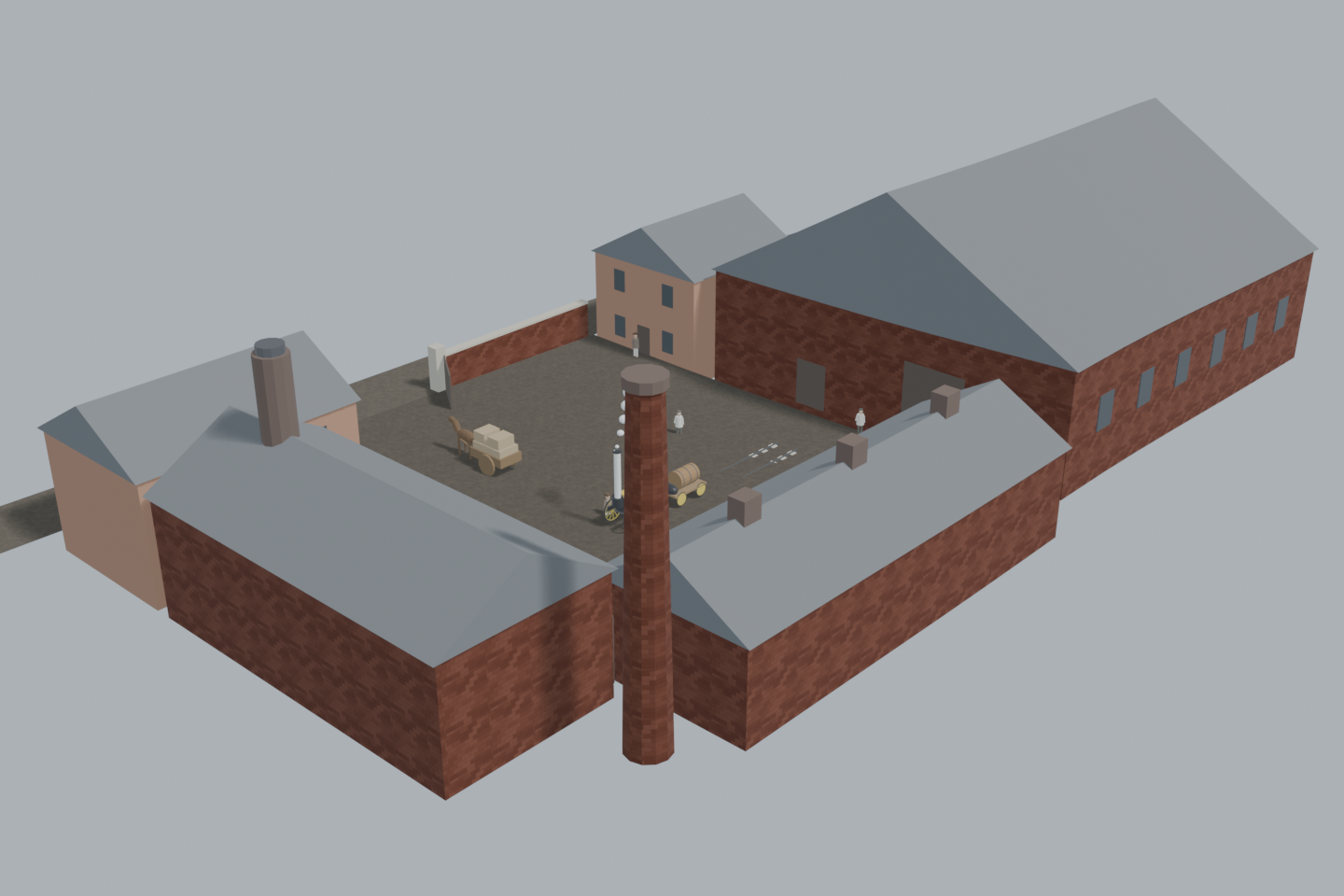
Robert Stephenson and Company's works on South Street, the first locomotive works in the world, in the weeks when Rocket was finished: the engine in steam in the yard with its tender, the long erecting shop, the smithy and the foundry with their chimneys, the counting house on South Street, and a heavy horse wagon waiting to take the engine, in pieces, to Carlisle for the voyage to Liverpool and the Rainhill Trials. The works' boiler shop still stands on the site as a music venue, the Boiler Shop.
View from anywhere. No camera or location permission needed.
2.4 MB · downloaded on demandDrag to orbit; scroll or pinch to zoom; right-drag or two-finger drag to pan. With the viewer focused: arrow keys rotate, +/− zoom, 0 resets.
Inside the green area the camera view shows the scene from where you really stand, at your real height — on a bridge you look down on it. Outside the area the app shows it from the marked demo point instead. Select a point on the map to check it, then load the 3D scene to preview the view from there.
The placement is a desktop reconstruction lined up with today’s map; it is not a surveyed position. Access, closures and sightlines on the ground are not checked.
Select a point on the map. Your location is requested only when you press “Check my location”.
South Street in September 1829: the world's first locomotive works has just finished the engine it will send to Rainhill.
The people and the wagon are fictional illustrations; the layout of the works is interpreted.
Load the 3D scene to visit these viewpoints.George and Robert Stephenson set up the works here in 1823 with Edward Pease and Thomas Richardson. Locomotion No. 1 for the Stockton and Darlington Railway was built here in 1825.
Twenty-five copper tubes through the boiler and a separate firebox made Rocket raise steam faster than anything before it. Its cylinders were set at a slant, driving the big front wheels directly.
Iron was forged in the smithy and cast in the foundry on the same yard. Much of an engine's work was done by hand.
There was no railway to Liverpool from here. Rocket was taken apart, carried by horse wagon to Carlisle, then by water to Liverpool, and rebuilt there by 18 September 1829.
The works' boiler shop and office still stand on South Street. The boiler shop is a music venue now, the Boiler Shop.
A study of the works on its real site, not of a recorded plan. Rocket follows the published dimensions (1.435 m driving wheels, 0.76 m trailing wheels, 2.16 m wheelbase, a 1 m by 1.83 m boiler, cylinders at 38°, a tall chimney); its 1829 colours are taken from the usual reading of the contemporary accounts. The works' buildings — counting house, erecting shop, smithy, foundry — are placed and shaped by interpretation around the surviving boiler shop between South Street and Forth Street. People and the wagon are illustrative. Not a surveyed reconstruction or an approved on-site AR installation. Horizontal placement uses a user-selected demonstration anchor.
Built to the published dimensions; the tender is a four-wheeled wagon with a water cask.
Between South Street and Forth Street, where the boiler shop and the office block still stand.
Counting house, erecting shop, smithy and foundry are placed and shaped by interpretation; no measured plan of 1829 has been used.
Rocket left Newcastle in pieces by horse wagon for Carlisle in September 1829.
Workmen and the gentleman by the engine are fictional; no portrait of a particular person is intended.