Every November Britain remembers those who died in war. Poppies grew on the churned-up battlefields of Flanders, and at eleven o'clock on 11 November 1918 the guns of the First World War fell silent.
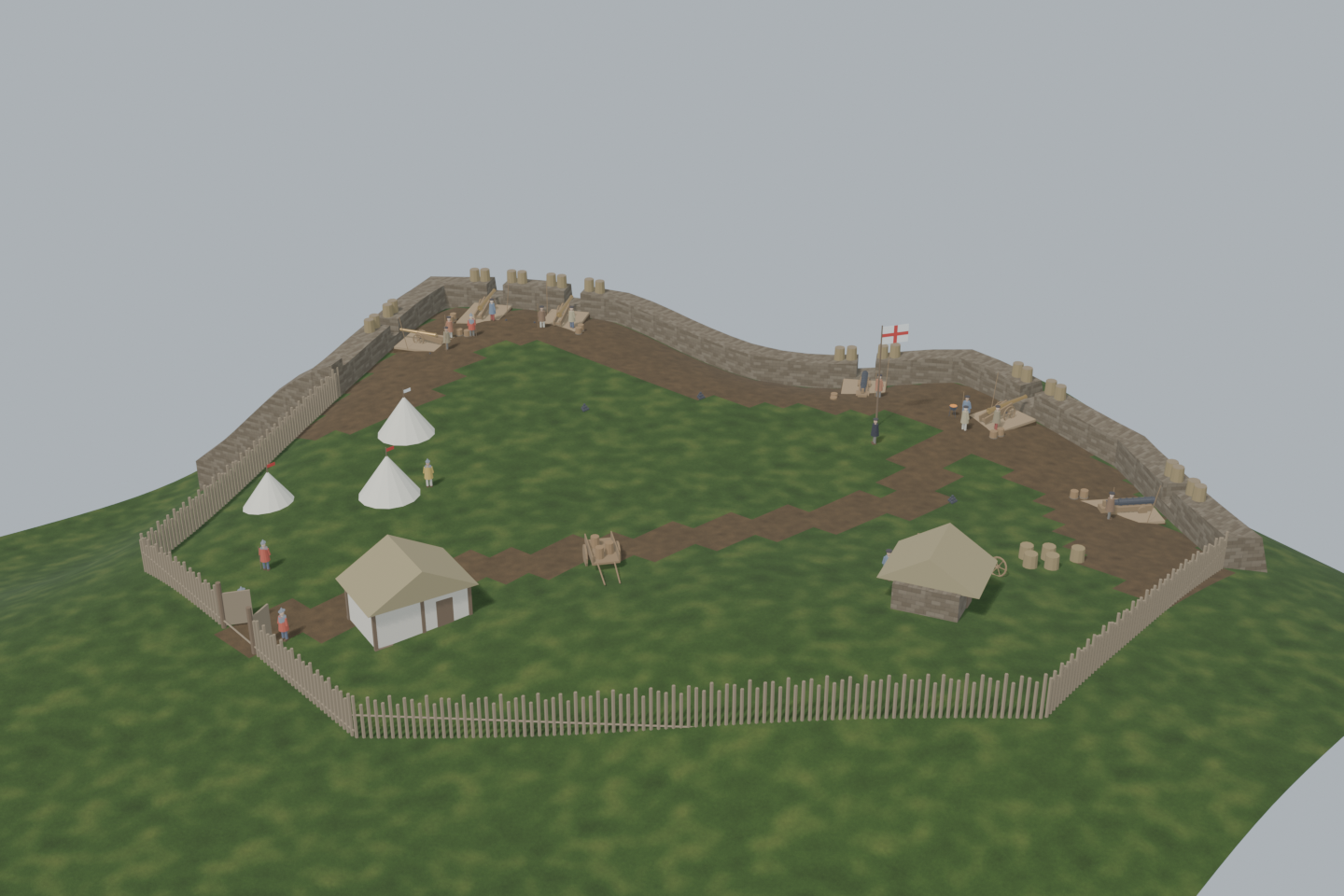
In 1545 Henry VIII had a gun battery built on the low promontory south of Tynemouth Castle, where the Spanish Battery Car Park is today, so that guns could cover the mouth of the Tyne while his fleet gathered in the river for the war with Scotland. Tradition says its guns were served by Spanish soldiers in the king's pay, and the place has been the Spanish Battery ever since. This scene stands the battery on the car park: a low stone parapet with gabions on the crest of the promontory, bronze culverins and iron port pieces in its embrasures, the gunners and the Spanish garrison, and the wall going on towards the castle.
Explore the reconstruction
View from anywhere. No camera or location permission needed.
3.9 MB · downloaded on demand
Drag to orbit; scroll or pinch to zoom; right-drag or two-finger drag to pan. With the viewer focused: arrow keys rotate, +/− zoom, 0 resets.
Where to see it on today’s map
Inside the green area the camera view shows the scene from where you really stand, at your real height — on a bridge you look down on it. Outside the area the app shows it from the marked demo point instead. Select a point on the map to check it, then load the 3D scene to preview the view from there.
Viewing areaHistorical wallModern site outlines
The placement is a desktop reconstruction lined up with today’s map; it is not a surveyed position. Access, closures and sightlines on the ground are not checked.
Select a point on the map. Your location is requested only when you press “Check my location”.
The king's guns at the river mouth
Stand on the Spanish Battery in 1545: Henry VIII's new battery, built so that guns could cover the mouth of the Tyne.
The people are fictional. The battery's plan, its guns and buildings are interpreted; no plan of 1545 has been used.
Load the 3D scene to visit these viewpoints.
A battery for the river mouth
Guns up on the castle's headland could not reach the mouth of the Tyne. In 1545 the king's engineers, Sir Richard Lee and the Italian Gian Tommaso Scala, planned new works, and this battery was built on the low promontory below the castle.
Guarding the fleet
England was at war with Scotland. The king's ships and transports gathered in the Tyne, and the battery's guns kept the entrance safe while they lay in the river.
Culverins and port pieces
Long bronze culverins, loaded from the muzzle, threw iron shot the furthest. Wrought-iron port pieces, loaded from the breech with a loose chamber, fired stone shot at close range.
The Spanish Battery
Tradition says that Spanish soldiers in the king's pay served the guns here, and the name stayed with the place for almost five hundred years.
Walls to the castle
Low stone walls formed the battery, and walls ran from it up to the castle and the priory. They were raised with brick in the Civil War and later lost; the guns came back in 1904, and the car park lies on the promontory now.
Evidence and interpretation
An interpretive study. The battery's place (the low promontory south of the castle, today's Spanish Battery), its date (1545), its purpose (covering the mouth of the Tyne for the king's fleet) and the low stone walls that formed it (as the 1643 repairs describe them) follow the Tyne and Wear HER and English Heritage. No plan of the 1545 battery has been used: its line along today's crest, its size, the number and kinds of guns, the gabions, the palisade at the back, the buildings and all activity are interpretive, drawn from English artillery works and guns of the 1540s. That Spanish soldiers served the guns is a tradition, not a record. Not a surveyed reconstruction or an approved on-site AR installation. Horizontal placement uses a user-selected demonstration anchor.
The battery's place and date — Recorded
On the low promontory south of the castle, built in 1545 to cover the mouth of the Tyne; today's Spanish Battery Car Park is on it.
Low stone walls — Recorded in the 1643 repairs; form interpretive
In 1643 'the low stone walls which formed the Spanish Battery' were raised with brick. Their line, height and the embrasures here are interpretive.
Guns — Interpretive
Bronze culverins and a saker on two-wheeled carriages and wrought-iron port pieces on wooden beds, the kinds of gun in English service in the 1540s; how many and which stood here is not recorded.
Gabions, palisade, buildings — Interpretive
Gabions by the embrasures, a palisade and gate across the back, a powder house, a guardhouse and tents are drawn from artillery works of the period, not from a record of this battery.
The wall towards the castle — Recorded; line interpretive
Walls connected the new battery with the priory; only its first stretch is shown, its line interpretive.
Spanish soldiers — Tradition
That Spanish mercenaries served the guns and gave the battery its name is a tradition; the people are fictional.
Cookies
Some are needed to run the game. One is not, and that is the one we are asking about.
Privacy Policy
Keeps you signed in and remembers the quest you are playing, whether or not you have an account. The game cannot work without these, so they are always on and there is nothing here to agree to.
One Google Analytics cookie, so we can see how many people play and which days are busy. It tells us nothing about who you are. We do not advertise and we do not pass it on. Turn it off and the game works exactly the same.