Out of the harbour
From the Round Tower — already a century old in 1545 — the Mary Rose slides past close enough to hear orders shouted on deck.
 Cairn
British History Quest

Every November Britain remembers those who died in war. Poppies grew on the churned-up battlefields of Flanders, and at eleven o'clock on 11 November 1918 the guns of the First World War fell silent.
The day the guns fell silent →19 July 1545 · leaving Portsmouth Harbour (interpretive)
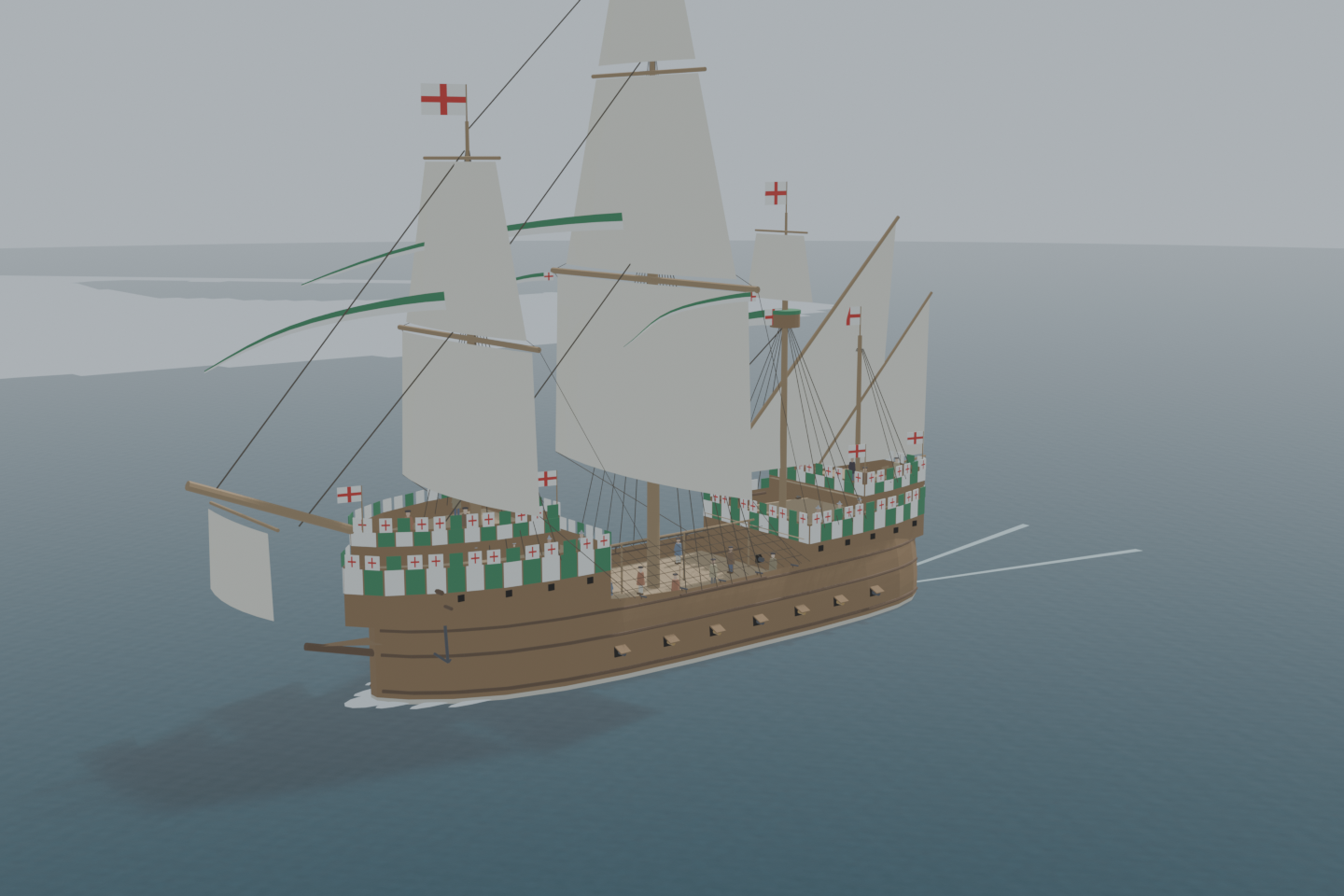
Henry VIII’s great carrack under sail in the narrow mouth of Portsmouth Harbour, a stone’s throw from the Round Tower: high castles fore and aft, seven open gunports a side, four masts, Tudor flags and streamers, soldiers under the boarding net. A French armada lies off the Isle of Wight. Within hours, off Southsea Castle and before the King’s eyes, she will heel over and sink.
View from anywhere. No camera or location permission needed.
2.9 MB · downloaded on demandDrag to orbit; scroll or pinch to zoom; right-drag or two-finger drag to pan. With the viewer focused: arrow keys rotate, +/− zoom, 0 resets.
Inside the green area the camera view shows the scene from where you really stand, at your real height — on a bridge you look down on it. Outside the area the app shows it from the marked demo point instead. Select a point on the map to check it, then load the 3D scene to preview the view from there.
The placement is a desktop reconstruction lined up with today’s map; it is not a surveyed position. Access, closures and sightlines on the ground are not checked.
Select a point on the map. Your location is requested only when you press “Check my location”.
19 July 1545: a French armada lies off the Isle of Wight and Henry VIII watches from Southsea Castle. His great ship stands out of the harbour.
The ship’s build is evidence-informed; her position here, the people and the colours are interpretive.
Load the 3D scene to visit these viewpoints.From the Round Tower — already a century old in 1545 — the Mary Rose slides past close enough to hear orders shouted on deck.
High castles fore and aft, and seven gunports a side on the main deck. Her heaviest guns are bronze culverins and cannon, with iron port pieces among them.
About 400 men are aboard: 200 sailors, 185 soldiers and 30 gunners. Netting stretched over the waist keeps boarders out — and, that afternoon, keeps the crew in.
Off Southsea, turning to bring her guns to bear, she heels; water floods in through the open gunports and she sinks in minutes. Fewer than 35 men survive.
Found and raised in 1982, her hull is now in the Mary Rose Museum in the Historic Dockyard, a short walk up the harbour from here.
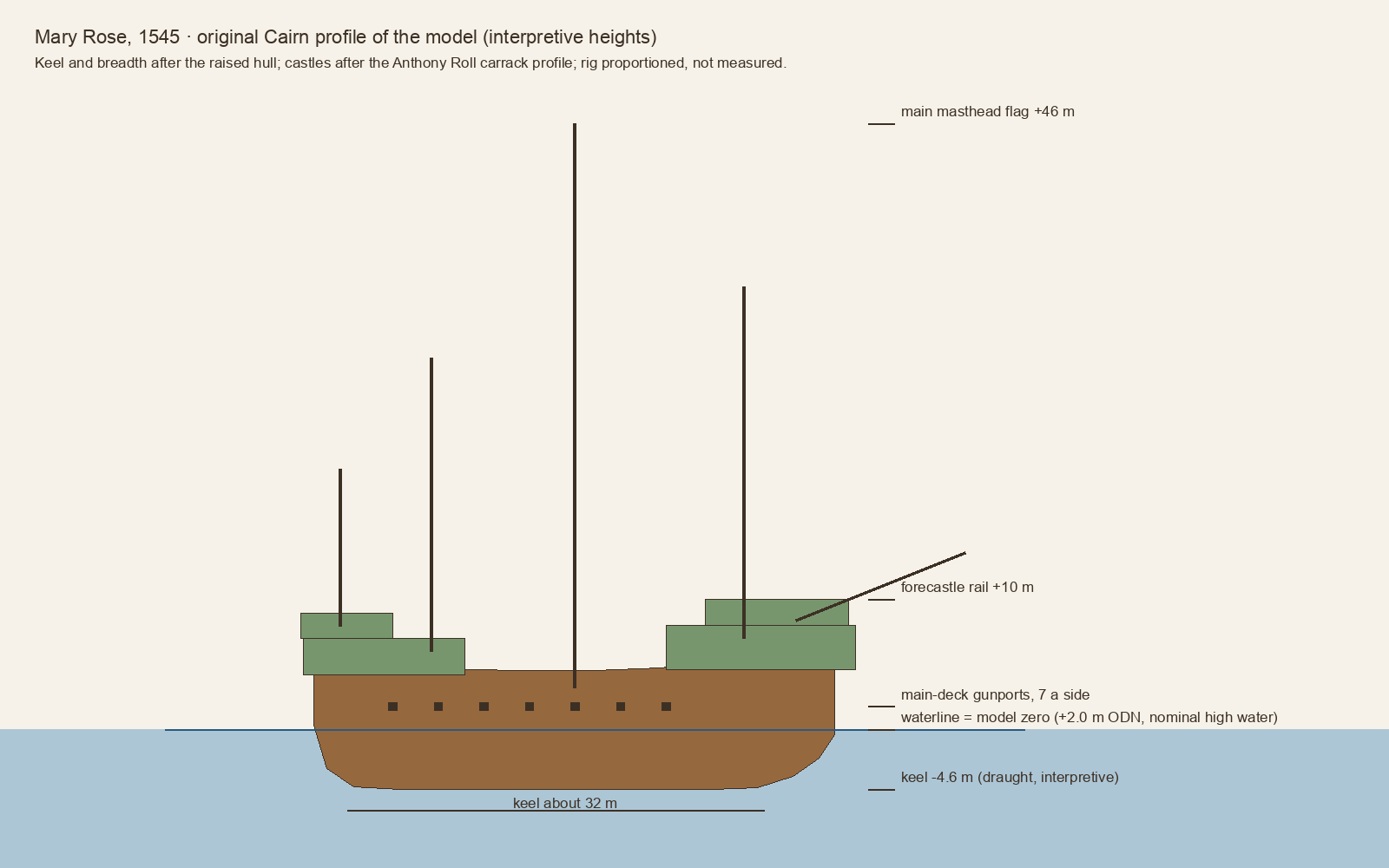
Mary Rose was built in Portsmouth in 1510–11, rebuilt about 1536 and lost in the Solent on 19 July 1545 while engaging the French fleet. Her keel (about 32 m), breadth (about 12 m), four masts with nine or ten sails, carvel hull, seven main-deck gunports a side and the boarding net over the waist follow the excavated hull and published research; the shape of the castles, the painted panels and flags follow the carrack profile of the Anthony Roll. Her position here, her exact course that day, the people on deck and all colours are interpretive. Water is a nominal high-water plane; tide, current access and native AR alignment are not calibrated. Horizontal placement uses an imagined water berth.
Keel and breadth follow the excavated hull; the beakhead, the overhanging forecastle, the stepped sterncastle and their heights interpret the carrack profile of the Anthony Roll. Seven lidded gunports a side on the main deck stand open, as they were when water poured in.
Four masts and a bowsprit: two square sails on the foremast, three on the mainmast, a lateen and a small square topsail on the mizzen, a lateen on the bonaventure mizzen and a spritsail. Spar lengths and sail areas are proportioned, not measured.
Tudor green-and-white panels and painted shields on the castles, St George’s crosses and long streamers follow the conventions of the Anthony Roll and other Henrician ship pictures; Mary Rose’s actual colours are not recorded.
The ship is in today’s deep channel about 95 m west of the Round Tower, heading out towards Spithead. The fleet lay in and off the harbour that week; her track on 19 July is not recorded, and the wreck lies in the Solent off Southsea, not here.
Fictional figures in Tudor dress and armour stand at the rails, in the castles and in the tops. No named person is depicted; Vice-Admiral Sir George Carew commanded her that day.