Before the shift
Miners collect hand lamps and meet outside the lamp cabin. Their working clothes are caps, shirts, waistcoats and boots rather than modern hard hats and electric cap lamps.
 Cairn
British History Quest

Every November Britain remembers those who died in war. Poppies grew on the churned-up battlefields of Flanders, and at eleven o'clock on 11 November 1918 the guns of the First World War fell silent.
The day the guns fell silent →Test location · An illustrative reconstruction at a chosen coordinate. This is not evidence of a mine at this site.
Around 1880 · an imagined North East colliery
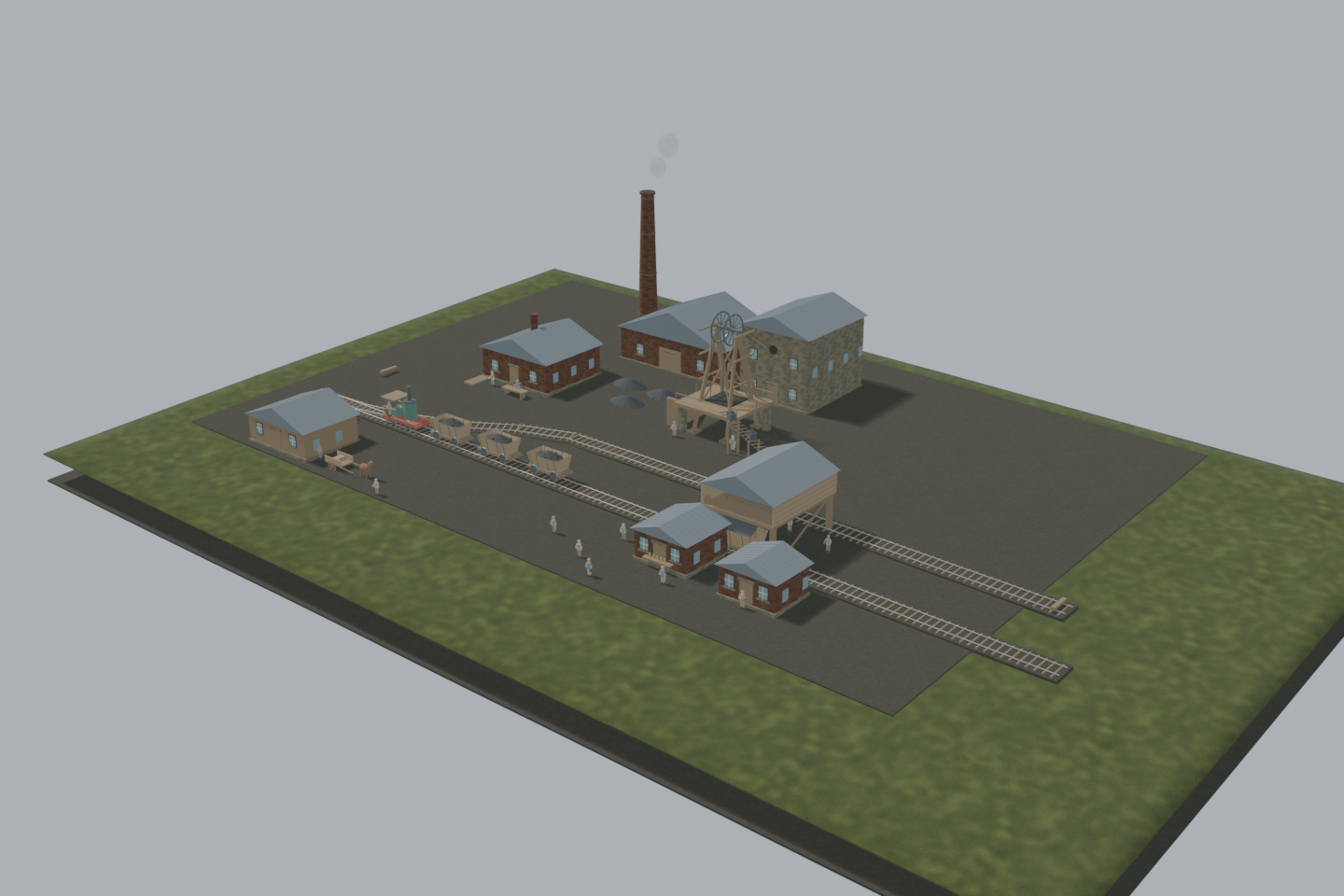
Coal was the "black diamond" of the Victorian North East. Step into an imagined colliery around 1880: winding wheels turning over the shaft, steam and brick, coal pouring through the screens into wagons, a little shunting engine and the miners of the day shift. The pit is invented — no mine is recorded at this field.
View from anywhere. No camera or location permission needed.
10.3 MB · downloaded on demandDrag to orbit; scroll or pinch to zoom; right-drag or two-finger drag to pan. With the viewer focused: arrow keys rotate, +/− zoom, 0 resets.
Inside the green area the camera view shows the scene from where you really stand, at your real height — on a bridge you look down on it. Outside the area the app shows it from the marked demo point instead. Select a point on the map to check it, then load the 3D scene to preview the view from there.
The placement is a desktop reconstruction lined up with today’s map; it is not a surveyed position. Access, closures and sightlines on the ground are not checked.
Select a point on the map. Your location is requested only when you press “Check my location”.
An imagined working day at a North East colliery around 1880, from the lamp cabin before the shift to coal leaving by rail.
An imagined pit at a chosen field, not a documented mine at this location. All people and events are fictional.
Load the 3D scene to visit these viewpoints.Miners collect hand lamps and meet outside the lamp cabin. Their working clothes are caps, shirts, waistcoats and boots rather than modern hard hats and electric cap lamps.
The winding wheels turn above the covered shaft landing. Small tubs carry the raised coal towards the screens; the mine workings below are outside this surface-only scene.
The raised screens separate coal before it drops into a waiting wooden wagon. A banksman and surface workers keep the pithead and loading area moving.
A small steam shunter moves three coupled coal wagons along a short yard run. A separate wagon stands beneath the loading chute. The tracks continue only as far as the diorama edge.
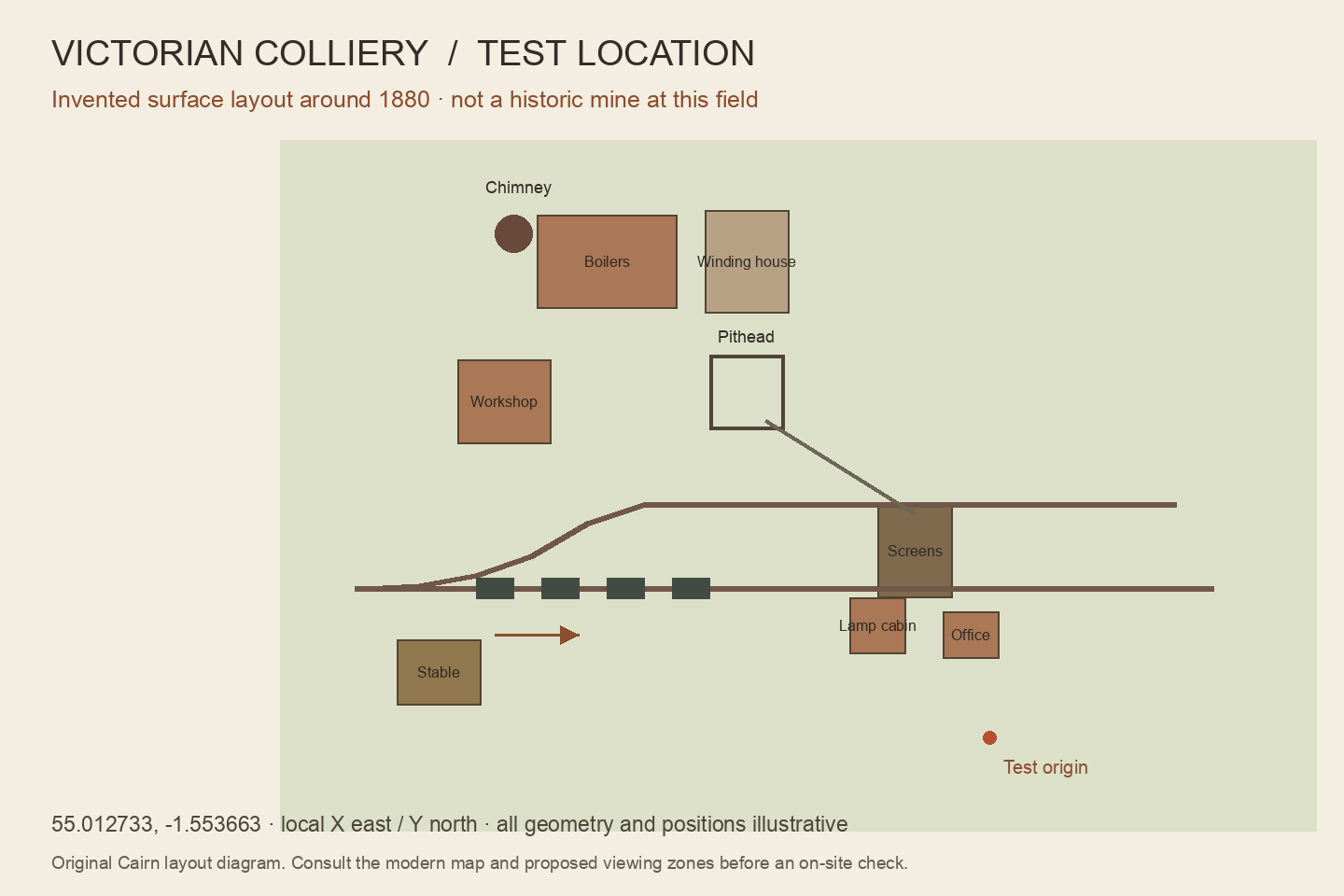
An imagined colliery surface around 1880, inspired by northern coalfield machinery and transport. No evidence has been established for this mine or railway at this field. All footprints, dimensions, buildings, characters and actions are interpretive. The placement is a chosen demonstration site; geographic accuracy, ground level, access and native AR registration still require on-site checks. Horizontal placement uses a user-selected demonstration anchor.
The scene centre stands at the chosen coordinate, with north-aligned model axes. No mine is asserted to have existed in this field.
A northern winding-house type with timber supports and spoked pulley wheels informs the design. Heights, proportions, brick chimney, rope routing and machinery details are authored interpretations.
A 92 m main track and short siding show coal leaving the screens. The small vertical-boiler shunter and wooden chaldron-style wagons are original simplified models, not replicas of a named working train. Track ends are scene cuts.
Sixteen fictional adults, a surface horse and cart, hand lamps, tools and stores suggest daily work. Clothing and actions are interpretive. No underground galleries are modelled.